State of North Carolina's Mental Health and Substance Use Services Workforce: Need, Supply, and Distribution Landscape Assessment
Data Snapshots
Concise profiles of each MH/SU services workforce in North Carolina.
Stay tuned for more profession snapshots.
Project Summary
North Carolina faces a critical challenge in meeting the mental health and substance use (MH/SU) services needs of its residents. With over one in five adults experiencing a mental health challenge and approximately 16% of the adult population affected by substance use disorders, the demand for MH/SU services has never been greater. This report provides a comprehensive analysis of North Carolina’s MH/SU services workforce in 2024 and examines the supply, distribution, characteristics, and capacity of professionals who serve individuals with mental health and substance use disorders across the state.
The MH/SU services workforce encompasses an array of professionals—from prescribers such as psychiatrists and psychiatric mental health nurse practitioners to graduate-level clinicians including psychologists, clinical mental health counselors, marriage and family therapists, and social workers; from specialized addiction counselors to allied health professionals like occupational therapists and speech-language pathologists; and from certified peer support specialists to MH/SU services support specialists who provide essential direct care services. Each occupation plays a distinct role in North Carolina’s MH/SU services care delivery system. Understanding how these professions work together to meet population MH/SU service needs requires a systematic analysis of workforce supply and distribution patterns.
This report synthesizes data from multiple sources– including state licensure and certification boards, the National Plan and Provider Enumeration System, the Medicaid Provider Enrollment File, the Bureau of Labor Statistics, and the American Community Survey—to provide the most complete depiction possible of the North Carolina’s MH/SU services workforce. The analysis examines the credentialing requirements, educational preparation, supply, demographic composition, and geographic distribution of the MH/SU services workforce in the state’s nine Area Health Education Center (AHEC) regions, four Behavioral Health and Intellectual/Developmental Disabilities Medicaid Tailored Plan catchment areas, and in NC’s metropolitan and nonmetropolitan counties.
Assessing MH/SU services workforce supply alone provides an incomplete picture. Thus, this report also documents the MH/SU services needs of North Carolina’s population, including prevalence rates of mental health and substance use disorders, patterns of treatment utilization, barriers to accessing care, and indicators of unmet need such as emergency department visits, crisis calls, and overdose and suicide deaths. By examining both workforce capacity and population needs, this analysis identifies geographic gaps in MH/SU services workforce supply.
The findings presented in this report are intended to inform policy decisions, workforce development initiatives, and strategic planning efforts aimed at strengthening North Carolina’s MH/SU services system. Understanding the state of North Carolina’s MH/SU services workforce can help target policies and interventions toward communities that need it most. As North Carolina continues to address the state’s ongoing MH/SU crises, data-driven insights about workforce capacity and distribution are essential to ensure all residents have access to the care they need, when and where they need it.
Suggested Citation: Lombardi BM, Headley J, Jimenez MP; Keesler R, Akue-ka AJB; Gregory R; Galloway E; Zerden LD; Fraher E. State of North Carolina’s Mental Health and Substance Use Services Workforce: Need, Supply, and Distribution Landscape Assessment. Program on Health Workforce Research and Policy. Cecil G. Sheps Center for Health Services Research. The University of North Carolina at Chapel Hill. March 2, 2026.
Publications
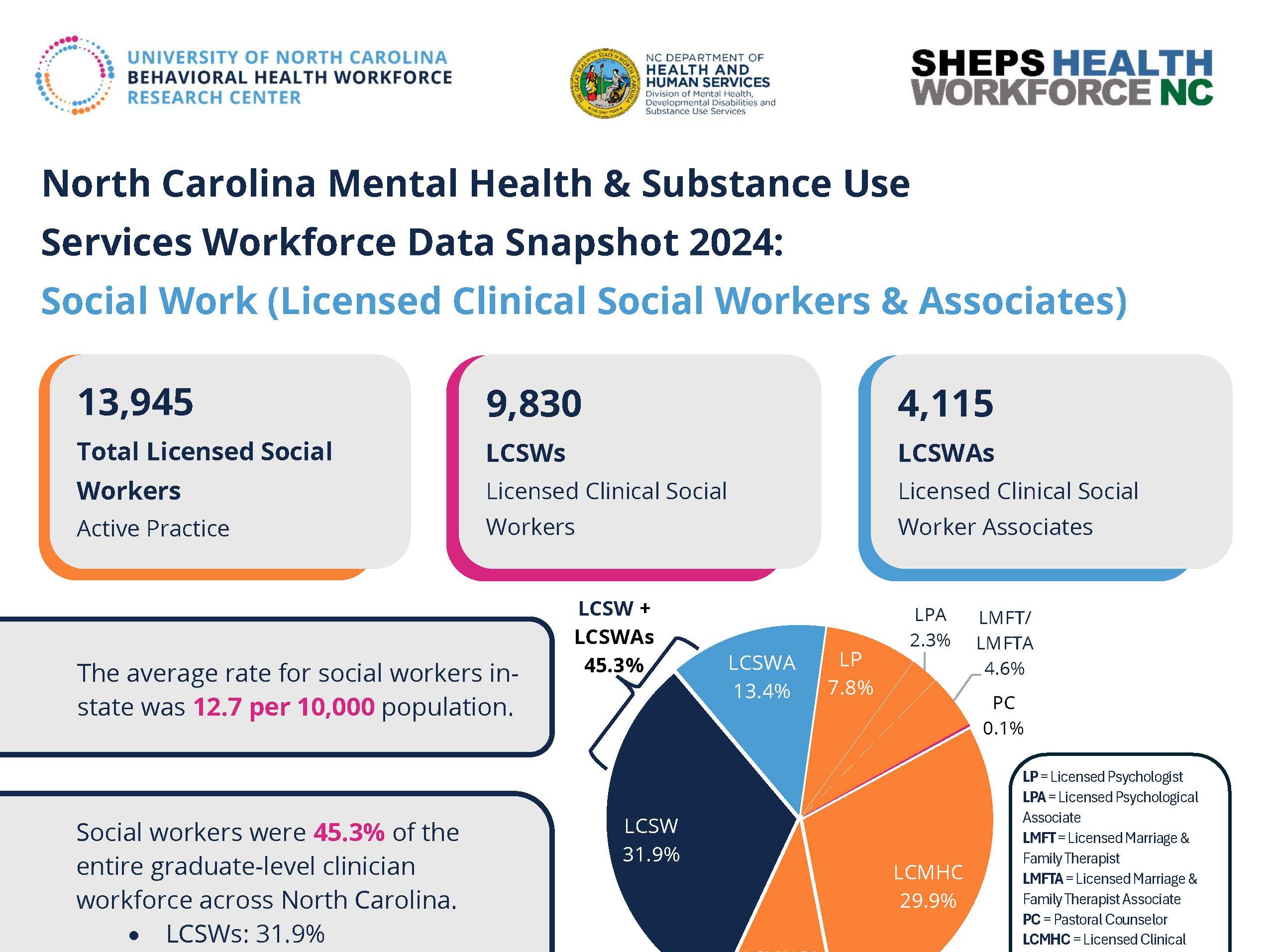
North Carolina Social Work Data Snapshot 2024
By — Mar 25, 2026
Data Snapshot: Licensed Clinical Social Workers & Associates